
by Christopher Grabau, Program Director, Reinert Center
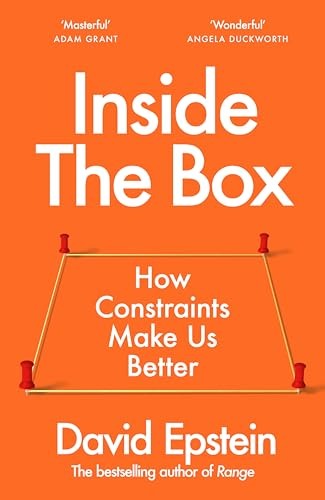
David Epstein’s central argument in his latest book, Inside the Box: How Constraints Make Us Better, is a useful consideration for anyone teaching. Limitations are not the enemy of creativity or growth, they are often the condition that produces it.
Open-ended freedom can feel generous, but it frequently overwhelms learners and exhausts their attention. Offering well-placed constraints on assignments and learning experience can help narrow the focus enough that students can actually move within it, experiment, and discover something they would not have found on their own.
The book includes many anecdotes of design constraints that not only support Epstein’s thesis but complement many of the long-standing theories on teaching and learning. While this connection is not explicitly addressed in the book, the similarities between Epstein’s articulation of creating constraints and what we know about effective teaching are hard to ignore.
Inside the Box is an entertaining and accessible book, and its central thesis may be a welcome contrast to our modern, decision-fatigued lifestyle. It may also offer an easy jumping off point for considering how constraints play into your own teaching practice. For example, below are a few simple instructional practices that complement Epstein’s perspective of providing constraints:
- Timed in-class activities: Give students a time limit for a discussion task, a problem set, or small group activity. The pressure of a clear endpoint tends to sharpen focus and reduce the perfectionism that stalls early drafts.
- Constrain choices in research papers and assignments: When assigning a research-paper, instead of an open prompt, offer a curated set of three or four options within a shared framework. Students can still exercise agency, but offering boundaries help them commit faster and go deeper rather than losing time to indecision.
- Offer concise and clear rubrics that support your course goals and objectives: Rather than a sprawling rubric that tries to capture every learning goal/objective, identify the two or three criteria that matter most for the assignment. Fewer, clearer constraints help students self-assess more accurately, help provide a road map for student success, and direct their effort where it counts.
- Structure peer feedback: Offering structured guidance on how to conduct peer feedback can help students focus their feedback in constructive and instructive ways. For example, instruct students to name one strength, one question, one suggestion tied to the assignment rubric. These constraints not only help guide student interaction but help students better prepare to receive and provide critique.
While these examples are far from comprehensive, I hope they help link the book’s themes to effective pedagogical practice. What unites them is that they show how thoughtful constraints serve the learner. When applied with care, constraints may be one of the insights faculty are most uniquely qualified to offer students.


